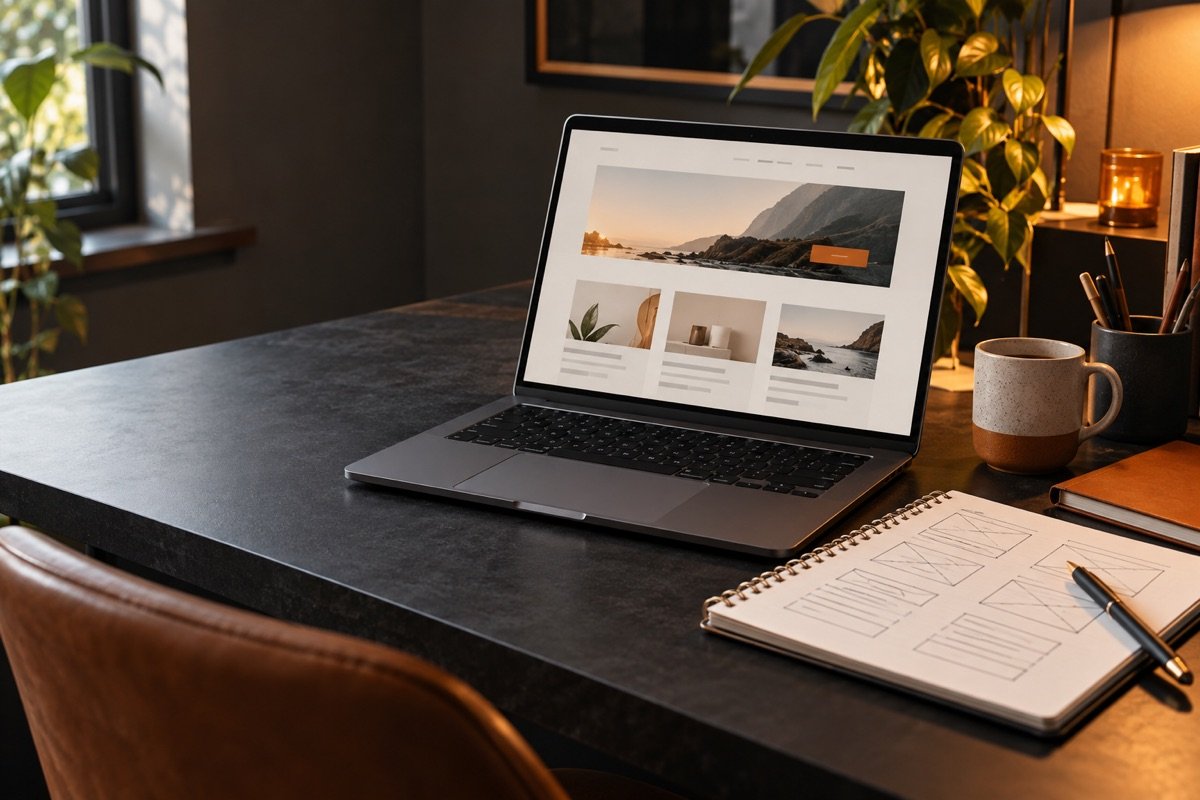
Most small-business websites are template swaps — the same Squarespace or Wix section stack with your logo dropped in. That's not a criticism of the tools; it's a description of the ceiling. Templates are built to look acceptable across ten thousand different businesses, which means they're built to look like nobody in particular. If your business has a real reputation, real reviews, and real results, a template quietly buries all of it under a generic layout your competitors are using too.
What "designed like a product" actually means
I design software before I design websites. That changes what a website is built from: a real design system — consistent type scale, spacing, color tokens, and component states — rather than a page-by-page improvisation. Buttons behave the same everywhere. Forms validate the same way everywhere. The site holds together as one considered object, not a stack of sections that happened to get built in order.
Custom, not templated
Every layout is built for your specific business, your specific proof points, and your specific customer's decision process — not a pre-built "services" section with your text dropped in. That includes information architecture: what a first-time visitor needs to see first is different for a dental practice than a landscaping company than a law firm, and the page is structured around that, not around a template's default order.
Conversion-first, not decoration-first
Design that doesn't move a visitor toward a call, a form, or a booking is decoration. Every page is built around one primary action, with proof (reviews, results, credentials) placed at the exact point a visitor is deciding whether to trust you, not buried in a separate "testimonials" page nobody clicks.
See it, don't take it on faith
This site is the pitch — it was built the way yours will be. The work section has further examples across different categories. And the risk-reversal is structural, not a sales line: you approve the design before you pay anything.
What's included
- Custom design system — type, color, spacing, and component states specific to your brand
- Information architecture built around your actual customer's decision process
- Mobile-first, accessible by default
- Integrated with the schema and content work from the Found pillar — design and findability built together, not bolted on after
FAQ
Do you use a page builder or write real code?
Real code, AI-accelerated. That's what makes both the speed and the Core Web Vitals scores possible — page builders carry overhead a hand-built site doesn't.
What if I don't like the initial design?
You review and approve the design before development starts, and before any payment beyond the initial deposit structure — see the packages page for exact terms.
See where you stand.
A free AI-visibility audit turns this advice into your specific numbers and fixes.
Your privacy, your choice
Essential site functions always run. With your permission, anonymous analytics help us understand which pages are useful. You can change this choice at any time.